“In any systemic reform, the greatest bottleneck is rarely goodwill, it’s a lack of infrastructure.”
Throughout my near 40-year career, I have observed public sector leaders who passionately want to build resilient, safer, and wealthier local communities, and private sector executives who genuinely want to prove their organisations are forces for good. I’ve been part of communities who are vocal about where issues lie, and the resources needed.
Yet, over the last 4 decades, I have seen these three forces operated in deep, isolated silos.
They are separated by fractured processes, conflicting legislation, risk-averse legal departments, and disconnect/outdated legacy technologies.
The Dual Impact Collaboration Model (DICM) Engine sits at the heart of my work and has evolved since 2013 when I began working within west Africa with governmental and international aid agencies. I co-designed and seeded the Engine to be the definitive answer to this systemic fragmentation. I built it not just as a software platform, but as a secure, neutral, and friction-free operational social equity environment that bridges the massive gaps of delivering a taxpayer return on investment (TRoI) within modern public procurement. It perfectly aligns with legislation and how public buyers procure and contract goods, services and works for their local communities; yet ensure supplier supply chain spend and social re-investment are locked-together and visible within supply contracts to establish social equity which is simple, legally compliant, and highly commercial.
.
“To build a cooperative framework that actually works, we had to systematically map and neutralise the three primary fractures that paralyse public procurement and supplier social value delivery.”
The Three Great Fractures (And How the DICM Engine Heals Them)
1) Healing the Legislative and Legal Gap
The introduction of the UK Procurement Act 2023 was meant to empower buyers to prioritise local benefit. Instead, it triggered widespread compliance anxiety: buyers must “maximize public benefit” yet their internal legal teams see demanding hyper-local outcomes will risk costly, anti-competitive supplier litigation; and a “KPI Trap” mandating buyers publicly report all supplier performance failures on major contracts.
How the DICM Engine Resolves This:
The engine acts as an objective compliance buffer. It translates the strict legal parameters of the Act into simple, pre-vetted, on-the-ground deliverables locked into contracts by aligning contract requirements directly to pre-verified local community needs, for absolute legal proportionality and relevance under the MAT framework—shielding the buying authority from anti-competitive risk while automatically generating the data needed to satisfy national auditors.
2) Overcoming Legacy Systems Intertia
The public sector is crowded with legacy e-tendering portals at framework and local levels, closed municipal databases with complex administrative software, and a raft of social value planning and reporting portals, which dominate the “KPI and self-reporting from suppliers. New social value solutions are almost always delayed or killed-off by buyer IT security reviews, long database migration queues and software integration costs to be approved.
How the DICM Engine Resolves This:
We designed the engine to run on a Zero-IT-Integration protocol. It operates entirely as an external, secure, and public-facing portal. Public sector buyers can instantly define, manage, and verify their localized social equity spend without making a single API change or software modification to their municipal legacy databases. This bypasses months of IT bottlenecks and unlocks immediate on-the-ground action.
3) Resolving the Commercial and Brand Divide
Private sector suppliers have historically struggled to bridge the gap between their corporate sales/marketing divisions and their on-the-ground delivery teams. In the race to win lucrative public tenders, bid-writing teams are incentivized to push inflated, unverified social value promises. Once the contract is won, these promises are often forgotten, leaving the supplier exposed to massive brand damage and debarment risks when their performance failures are published on national registers.
How the DICM Engine Resolves This:
The engine replaces speculative bidding promises with contract-live Social Purchase Orders (SPOs). It actively matches a supplier’s unspent or expiring corporate assets—such as expiring Apprenticeship Levy funds or corporate capex—directly with verified local VCSE partners. This automates the delivery of their social commitments, protects their brand from post-award compliance liabilities, and gives them a powerful qualitative differentiator to win future MAT bids on quality rather than a price-cutting race to the bottom.
From Bidding Promises to Verified Reality: Connect, Capture, Measure & Promote
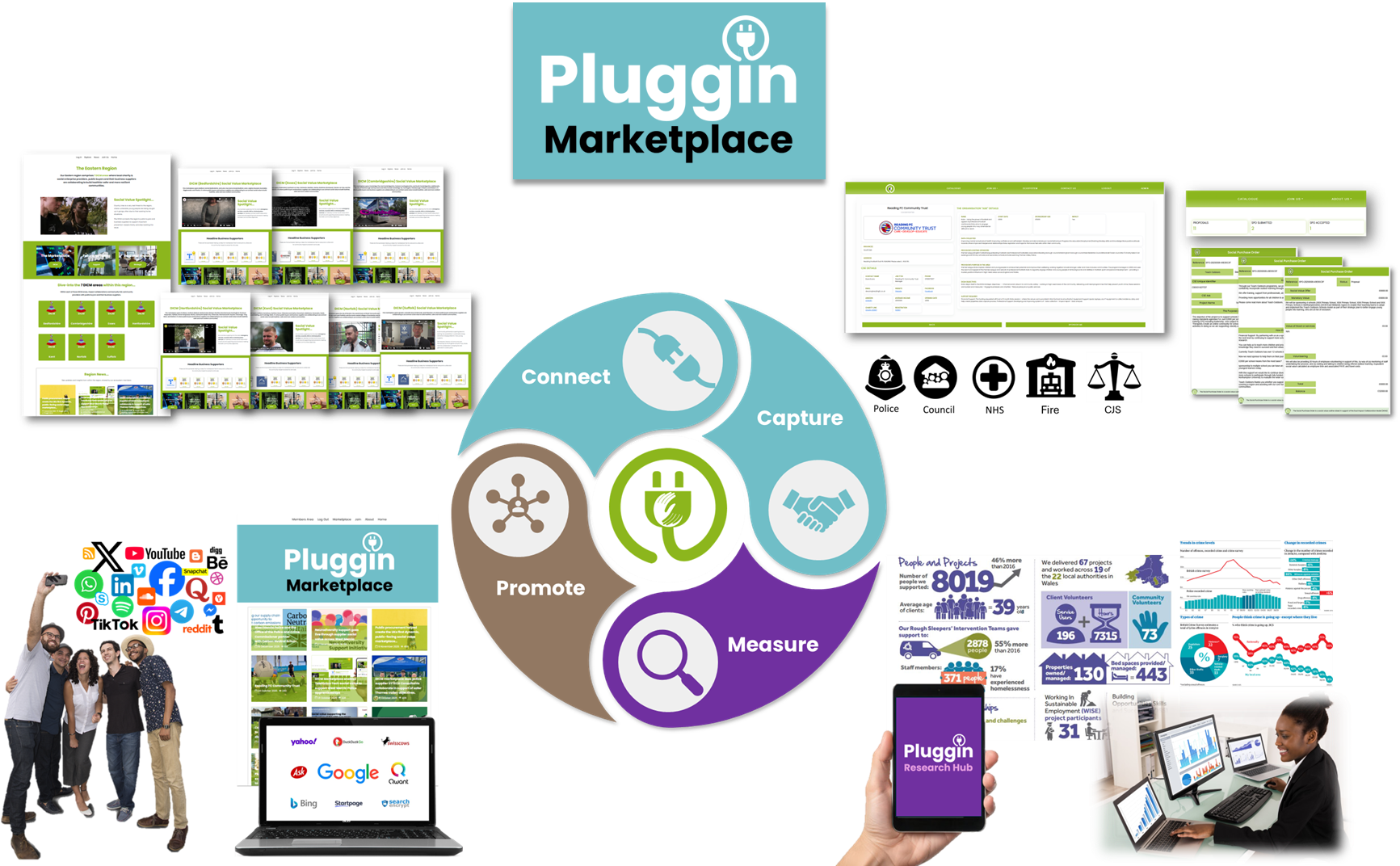
At the absolute centre of the DICM Engine is the model for transformational collaborations which play out inside a social value marketplace for all to see. This has replaced the speculative, abstract “proxy financial scores” used by legacy portals with a clean, transparent, and auditable transaction ledger.
By ensuring that each pound of committed corporate social investment generates a distinct, non-duplicative, and locally verified digital receipt, the DICM Engine provides public sector Chief Financial Officers with a unique picture of their transparent Taxpayer Return on Investment (TRoI).
This is proving that targeted, supplier-funded social value can directly reduce the downstream financial demands on public health, emergency services, and social care—safeguarding statutory budgets by best utilising private supply-chain resources and capital.
.
Stepping Into the New World
The transition to the Procurement Act 2023 no longer requires massive administrative budgets, long IT integration delays, or expensive software monopolies.
As demonstrated by the West Mercia regional collaboration, where police, fire, and surrounding county councils are coordinating social value across £1.3 billion of joint spending, this cooperative, data-driven, and frictionless social value marketplace is already a working reality and scaling quickly within other regions.
The DICM Engine is the operational heart of this movement—proving that when you make social equity simple, secure, and commercially advantageous, you can scale place-based community wealth safely from its current £2.1 billion to over £10 billion of public spending.
To explore the underlying design and transaction validation protocols of the DICM Engine, click through: